
The State budget is a centralized financial fund and represents the state’s revenue and expenditure balance for a given calendar year. Individual revenues and expenditures of state budget are further divided into individual chapters expressing the scope of competence and responsibility of individual central government bodies.
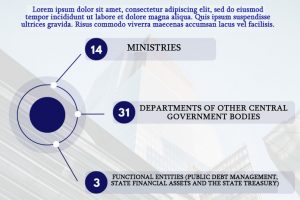
The state budget has 48 chapters (the list of all the chapters can be found here):
- 14 chapters for ministries,
- 31 chapters for other central government bodies, and
- 3 operational chapters (for state depth, state financial assets and state treasury).
The central government bodies who have their own budget chapter are called Chapter administrators (in case of the operational chapters, the state administrative body is the MF) and are responsible for budget allocation for the organizational units of the state and state contributory organization in their scope of competence.
State budget takes the form of a law. The budget process begins with the preparation of the budget proposal by individual ministries and government bodies, which is then consolidated by the Ministry of Finance. The MF shall inform the administrators of the chapters on preliminary budget allocation and other binding numerical data (budget indicators) by the end of June. The administrators of the chapters proceed similarly to the budgetary organizations in their scope (the state organizational units, funds, contributory organizations) and consequently submit their respective chapter’s budget to the MF by the end of July.
The proposed budget is reviewed by the Cabinet and subsequently submitted to the lower chamber of the Parliament. After the bill on the state budget is submitted to the Chamber of Deputies, the Speaker of the Chamber orders it to be considered by the budget committee. Only then does the first reading in the plenary session follows. The Parliament scrutinizes and debates the budget, suggesting amendments if required, before passing it into the law:
First reading: In a general debate, the Chamber of Deputies discusses the basic data of the bill on the state budget, which are the amount of income and expenditure, the balance, the method of settlement of the balance, the overall relationship to the budgets of higher territorial self-governing units and municipalities, and the extent of the empowerment of executive bodies. The Chamber of Deputies either approves the proposed parameters of the state budget or recommends changes. New proposal must be submitted in a 20–30 days’ time. Together with the approval, the Chamber of Deputies orders committees that are to discuss the mandated chapters. The committees adopt resolution or elaborate opposition reports for each budget chapter ordered to them. Should the committee suggest any change, it is required to request the opinion of the respective chapter’s administrator. They submit their stand back to the budgetary committee in due time. The minimum time for discussion of the mandated chapter of the bill on the state budget in the committee is 5 days. Budget committee adopts a resolution on those assessments that has to be delivered to all deputies at least 24 hours before the start of the second reading.
Second reading: A detailed debate is held on the draft law on the state budget and the budget committee’s resolution on it, in which amendments or other proposals are submitted. A summary of the submitted amendments, or other proposals, shall be delivered to all deputies and the proposer.
Third reading: A final debate is held, in which only corrections of legislative technical errors, grammatical errors, written or printing errors can be proposed, or adjustments that logically follow from the presented amendments. A proposal to repeat the second reading may be submitted.
The budget’s execution is monitored by the Ministry of Finance throughout the fiscal year, the ministry also continuously evaluates the cash flow of the state budget and submits information about it to the government after the end of the first and third quarters so that the Cabinet submits it to the Budget Committee of the Chamber of Deputies by the end of the month following the end of the calendar quarter. The Cabinet is responsible for the implementation of the budget to the Chamber of Deputies. Upon the end of half-year, the Cabinet submits a report (mid-term review) to the Chamber of Deputies, evaluating the development of the economy and the implementation of the state budget; the report also contains an assessment of the fulfillment of the territorial budgets and the development and current state of state financial assets, state guarantees, and state debt.
In the year following the fiscal year, the Ministry of Finance is responsible to coordinate the work and finally elaborate the draft of the Final State Account, a comprehensive document that includes an overview and interpretation of the budget implementation including macro-economic overview and development, situation regarding the state debt, final amounts of revenues and expenditure and breakdown tables of economic indicators of all budgetary units. The proposal is to be submitted by the Cabinet to the Chamber of Deputies by the end of April – chapter administrators first submit their chapter’s final account to the respective committee, finally, the Chamber of Deputies negotiates and approves the Final State Account.