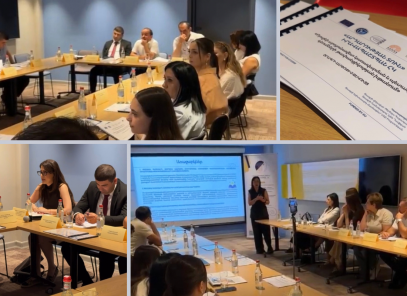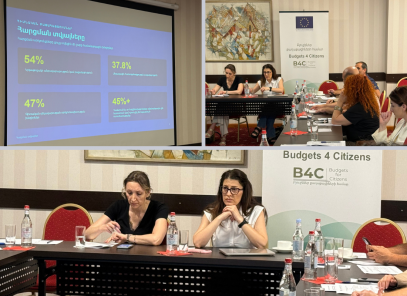
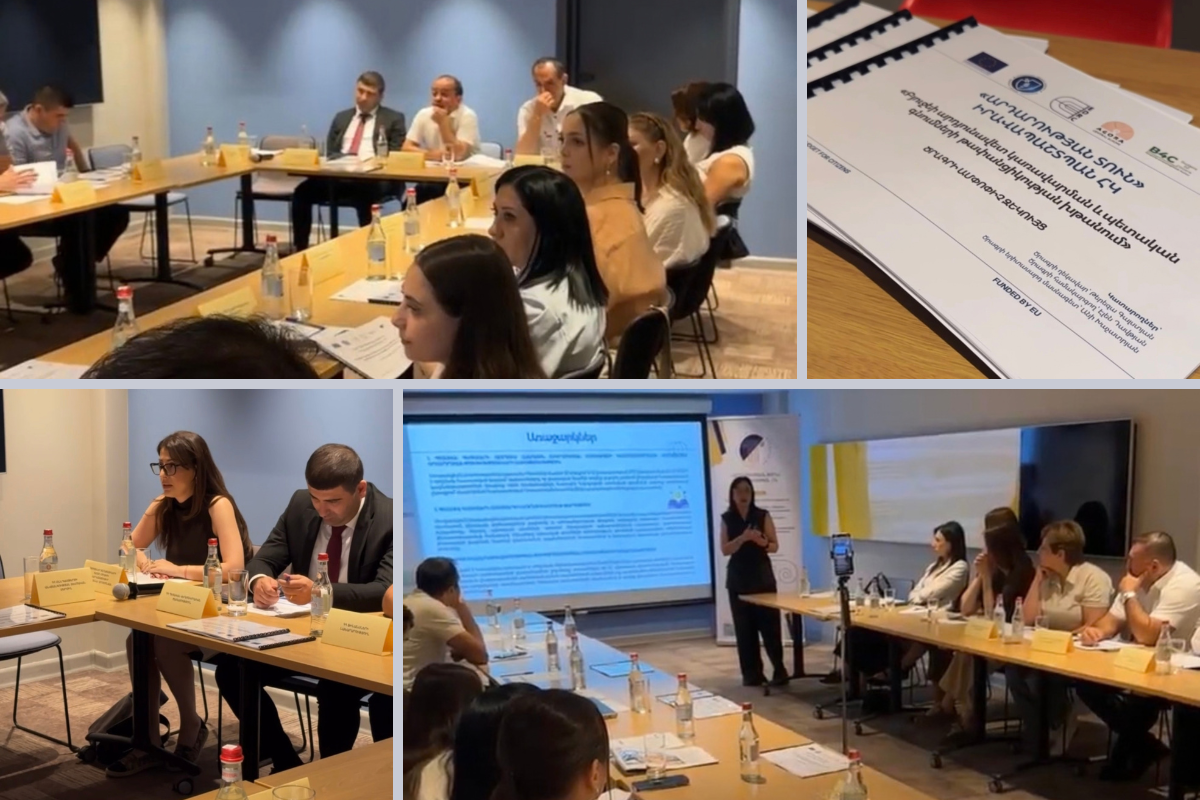
On 17 September, 2026, a conference to present and discuss the results of a sub-grant “Promoting Effective Budget Management and Transparency in Public Procurement” was held. The Human Rights Defense NGO “House of Justice” implemented the project within the framework of the “Budgets for Citizens” program, which is implemented the financial support of the European Union.
Ms Tereza Galstyan, the President of the Human Rights Defense NGO “House of Justice”, delivered opening remarks, presented the objectives of the program and the main areas of the study. She emphasized the importance of analyzing public procurement processes, contract management, the effectiveness of budget expenditures, and the link between budgetary spending and contract outcomes. She also highlighted the role of such studies as an effective tool for public oversight and the improvement of public administration.
Representative of the “Armenian Lawyers’ Association” NGO Ms Syuzanna Soghomonyan, who is also the Advocacy Expert of the “Budgets for Citizens” program, delivered welcoming speech as well. She outlined the general logic of the work being carried out under the program, emphasizing the importance of civil society participation and constructive cooperation with government bodies in budgetary processes.
Representatives of a number of ministries and other entities attended the event as well, among them Mr. Gor Mehrabyan, Head of the Procurement System Support Division of the Ministry of Finance of the Republic of Armenia; Mr. Alik Hovhannisyan, a representative of the Ministry of Territorial Administration and Infrastructure of the RA; Mr. Samvel Sargsyan, representative of the MIA General Department of Community Police of the RA; Ms Margarita Poghosyan and Ms Naira Karapetyan representatives of the Anti-Corruption Committee of the RA; Mr. Aram Gasparyan, representative of the State Supervision Service of the RA; Ms Araksi Sirekanyan, representative of the Food Safety Inspection Body of the RA; representatives of the Yerevan Municipality, Ms Edita Simonyan, Ms Hasmik Papyan, Ms Larisa Aghajanyan, Ms Elen Keghinyan, and Ms Tatevik Manukyan; Ms Karine Beganyan, representative of the Aragatsotn Regional Administration of the RA; Mr. Suren Safaryan, representative of the Armavir Regional Administration of the RA; Mr. Gagik Khandanyan, representative of the Gegharkunik Regional Administration of the RA; Ms Gohar Khachatryan, representative of the Vayots Dzor Regional Administration of the RA; Mr. Ashot Barseghyan and Mr. Seyran Grigoryan, representatives of the Vardenis Municipality; Mr. Artak Avetisyan, representative of the Sevan Municipality as well as other representatives of the civil society.
Ms Tereza Galstyan, the President of the Human Rights Defense NGO “House of Justice”, presented the key findings, issues of concern, and recommendations regarding public procurement and other processes for acquiring goods and services carried out by state and local self-government bodies in Armenia during the period of 2023–2025.
More than 30 public procurement procedures conducted in 10 regions of the Republic of Armenia in 2025–2026, as well as the contracts concluded on their basis, were analyzed in the framework of the project. One specific area of the study involved examining the legality of public procurement processes organized by municipalities, as well as contract performance and the acceptance of results, regarding the acquisition of services for the sterilization and neutering of stray animals.
The conducted Studies have identified a number of recurring and systemic issues. In particular, different procurement procedures and CPV codes were used to procure similar services across various communities, and there was a lack of unified or sufficiently clear technical specifications for these services.
In a number of instances, technical specifications lacked measurable and verifiable criteria that would have enabled subsequent documentation of the services provided, as well as their scope and quality. Consequently, at the contract implementation and service acceptance stages, clients sometimes lacked sufficient evidence confirming that the services had actually been delivered.
The study also identified cases where reasonable doubts arose regarding the authenticity of documents and data submitted by participants; nevertheless, representatives of the client issued favorable conclusions, and the services were accepted and payments were made.
In this context, the results of the analysis conducted under the project in addition to the issues related to the performance of individual contracts also reveal systemic shortcomings in the processes by which government clients accept and monitor contract deliverables. In particular, cases involving insufficient human and professional resources, limited knowledge among employees involved in procurement processes, and even inadequate awareness of their own oversight powers and responsibilities were recorded.
In a number of communities, alleged acts punishable under Articles 255, 283, 307, and 441 of the Criminal Code of the Republic of Armenia were identified; accordingly, reports regarding the alleged crimes were forwarded to Armenian law enforcement agencies. Criminal proceedings have also been initiated in active cooperation with the State Supervision Service of the RA.
Based on the findings of the studies, the organization has presented a series of systemic recommendations.
First and foremost, it is proposed to improve the mechanism for public oversight in the sphere of public procurement by legally providing for the participation of civil society organizations that are included in the relevant list maintained by the authorized body at all stages of the procurement process, starting from the publication of the notice to the full performance of the contract.
The second key area of focus is the development of human resources within the public procurement system. It is proposed to assess the staffing levels in procurement units, increase the number of specialists where necessary, and implement a system of mandatory continuous training.
The training programs should cover not only procurement legislation but also procurement planning, the preparation of technical specifications, bid evaluation, contract management, and the monitoring of contract performance. The training programs in addition to procurement legislation should cover procurement planning, the preparation of technical specifications, bid evaluation, contract management, and the monitoring of contract performance as well.
The third focus area entails improving the mechanisms of interaction between state and public oversight; specifically, in light of changes to the supervisory powers of the State Supervision Service of the Republic of Armenia, this involves ensuring effective procedures for reviewing materials submitted through public oversight channels, assessing potential violations, and responding to them. It is also proposed to develop unified methodological guidelines for preparing technical specifications, establishing measurable and verifiable requirements, approaching preliminary market analysis, and setting criteria for excluding wording that may restrict competition.
Another key proposal is to move beyond limiting oversight of public procurement to a mere check of procedural compliance, and instead implement mechanisms that also allow for the assessment of the final outcome achieved under the contract. For this purpose, it is proposed to conduct sample-based checks of contract performance, regularly analyze common violations and risks, and use the findings in the process of evaluating the performance of contracting authorities and suppliers.
The issue of the lack of unified statistics regarding potential abuses in the procurement sector has also been raised. According to the assessment of the organization, the lack of systematic statistics on relevant pre-trial and judicial practice hinders the assessment of sector-specific risks and the development of effective measures to prevent them.
Representatives of government agencies expressed their readiness to provide written responses regarding the submitted proposals and to discuss the possibility of incorporating them into the relevant draft documents to be developed in the near future.